
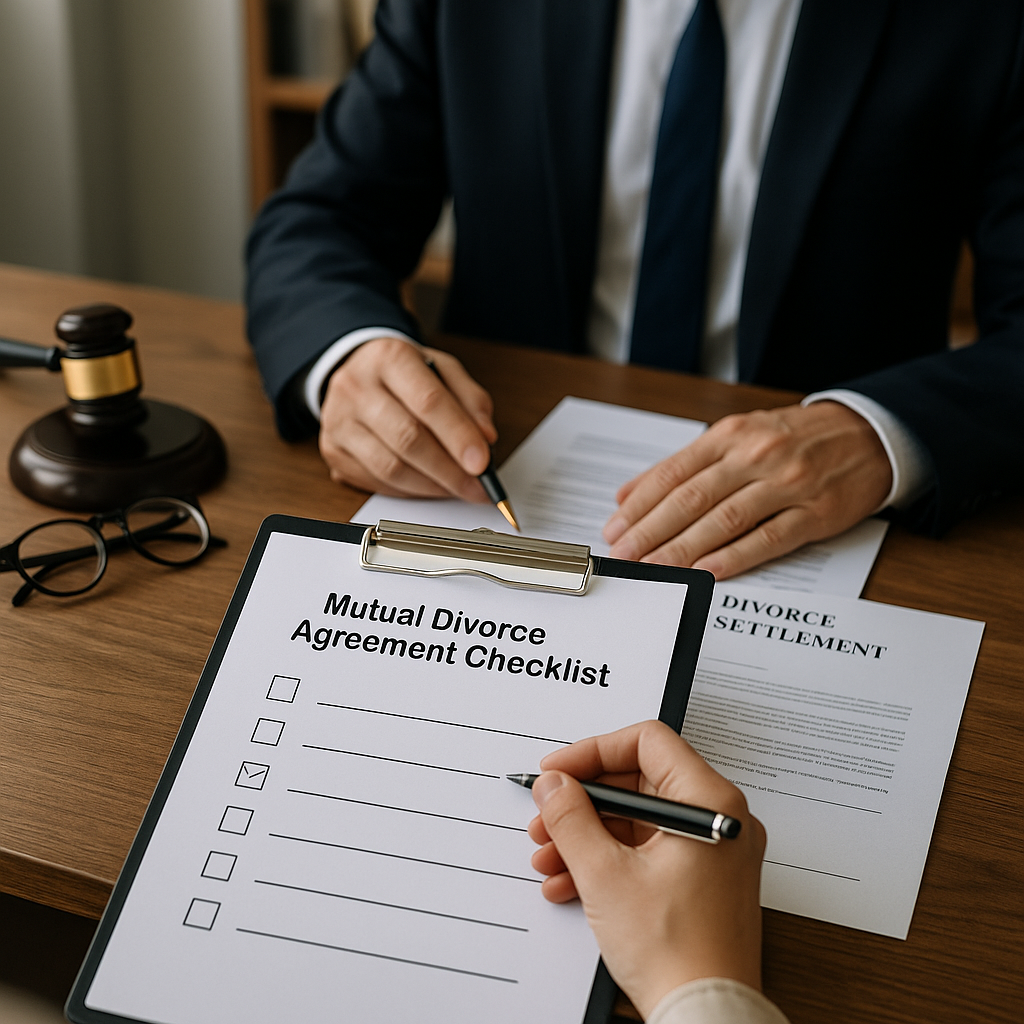
Drafting a Mutual Divorce Agreement: Lawyers’ Checklist for Avoiding Delays
Introduction
You’re sitting across from your client in a stuffy office, forms piled high, both partners nodding that they “just want it over with.” Still, the last thing anyone wants is a mutual divorce agreement stuck in endless legal limbo. In India, mutual consent divorce should be straightforward – but small mistakes, missing signatures, or unclear terms can drag the process out for months.
That’s why a clear, lawyer-tested Mutual Divorce Agreement Checklist matters. It’s not just about ticking boxes. It’s about avoiding delays, ensuring every legal document is watertight, and getting court approval without running back for corrections. Whether you’re a family law professional or a couple trying to understand the process, knowing exactly what goes into a solid mutual divorce agreement can save time, money, and emotional energy.
This guide lays out what to check, what to avoid, and how top mutual divorce lawyers keep things moving. We’ll look at real-world pitfalls, practical drafting tips, and the step-by-step framework that makes mutual consent divorce as painless as possible.
Quick Answer
Mutual Divorce Agreement Checklist:
– Confirm both parties’ consent and mental capacity.
– List all marital assets, debts, and settlement terms clearly.
– Specify child custody, visitation, and maintenance arrangements.
– Attach all required supporting documents (proof of marriage, ID, address, income).
– Obtain signatures from both parties and two witnesses.
– File with the correct court and attend both motion hearings.
– Double-check for errors to avoid court objections or delays.
What Is a Mutual Divorce Agreement?
A mutual divorce agreement is a legally binding document where both spouses agree to end their marriage on agreed terms. In India, this falls under Section 13B of the Hindu Marriage Act and other personal laws. The agreement covers splitting assets, child custody, maintenance, and any other settlements.
Key Elements
- Consent: Both spouses must agree without pressure.
- Terms: Details on property, money, children, and future rights.
- Legal Documents: Copies of marriage certificate, proof of address, income statements, and other required papers.
- Court Approval: The agreement is only valid after the court reviews and approves it.
Why Is It Needed?
Without a written agreement, mutual consent divorce can get stuck. Courts want clear proof that both partners understand and accept the settlement. A vague or incomplete document risks rejection, fresh arguments, or extra hearings.
Typical Scenarios
- Couples who want a clean, quick separation without fighting.
- Spouses who’ve already divided their property and need legal closure.
- Parents agreeing on joint custody and maintenance, looking for stability for their child.
Why a Checklist Prevents Delays
A mutual divorce agreement checklist is more than a formality. It’s a practical tool that helps lawyers and clients avoid common mistakes that slow things down.
Direct Benefits
- Reduces Errors: Missing signatures, incomplete asset lists, or unclear language can force repeat court visits.
- Saves Time: Judges and court staff move faster when documents are in order.
- Protects Clients: Ensures both parties’ interests are fairly represented.
Common Causes of Delay
- Missing or incorrect legal documents (like an expired ID or old address proof).
- Disagreement on child custody or maintenance at the last minute.
- Vague or ambiguous terms that confuse the court.
- Incomplete asset or debt disclosures.
- Unclear division of property, especially for jointly owned homes or businesses.
Real-World Example
A couple from Pune almost had their consent divorce rejected because they forgot to attach the latest salary slip. The court demanded proof of income to validate the maintenance amount. A simple checklist would have flagged this before filing.
The Ultimate Mutual Divorce Agreement Checklist
A thorough checklist is your shield against delay. Here’s a lawyer-approved version for Indian mutual consent divorce cases.
1. Confirm Consent and Eligibility
- Both parties are willing and mentally sound.
- Marriage lasted at least one year (unless exempted by law).
- No pending criminal cases or restraining orders between spouses.
2. Personal and Marriage Details
- Full names, dates of birth, and addresses of both spouses.
- Date and place of marriage.
- Marriage certificate attached.
3. Settlement of Assets and Liabilities
- List of all movable and immovable property (house, car, jewellery, bank accounts).
- Statement of any loans or liabilities.
- Clear division plan (who gets what, sale proceeds split, etc).
- Transfer documents or NOCs if needed.
4. Child Custody, Visitation, and Maintenance
- Names and ages of children.
- Custody arrangement (sole, joint, or shared).
- Visitation schedule (weekends, holidays, festivals).
- Maintenance or alimony amount and payment method.
5. Spousal Maintenance and Alimony
- Amount agreed, payment schedule, and duration.
- Bank details for transfer.
- Waiver clause if both waive future claims.
6. Required Legal Documents
- Proof of identity (Aadhaar, passport, voter ID).
- Address proof for both spouses.
- Four passport-size photos each.
- Proof of income (salary slip, ITR, business statement).
- Proof of residence separation (rental agreement, utility bills).
7. Signatures and Witnesses
- Both parties sign every page of the agreement.
- Two witnesses (not family) sign and provide ID copies.
8. Court Filing and Motion Hearings
- File in court with two sets of documents.
- Attend first motion (statement recorded).
- Wait mandatory cooling-off period (usually 6 months, sometimes waived).
- Attend second motion for final order.
9. Final Review
- Double-check for blank spaces or spelling errors.
- Verify all annexures are attached.
- Cross-check court requirements for your city or state.
How to Draft a Solid Mutual Divorce Agreement
Drafting a mutual divorce agreement isn’t just filling in blanks. It’s about getting every detail right and making sure the court won’t send you back for corrections.
Step-by-Step Drafting Process
- Initial Consultation: Meet both clients separately and together. Confirm consent, discuss key issues (property, custody, maintenance), and list all concerns.
- Information Gathering: Collect all documents upfront – marriage certificate, ID, proof of address, income, property papers.
- Draft Agreement: Use a reliable template but customise every section. Avoid copying from old files without updates.
- Detailed Terms: Spell out every asset, liability, and arrangement. Don’t leave terms like “reasonable visitation” without clear schedules.
- Review with Clients: Go over the draft line by line. Check for confusion or hidden disagreements.
- Witness and Notarise: Arrange for two independent witnesses. Notarisation isn’t mandatory but adds credibility.
- Final Filing: Submit at the right family court with all annexures, affidavits, and applications.
What to Avoid
- Vague language (“as agreed by parties later”).
- Missing annexures or unsigned pages.
- Failing to specify what happens if one party defaults on maintenance.
- Ignoring local court rules (some courts want extra affidavits).
Sample Clause (for Reference)
“Both parties agree that the custody of the minor child, Aarav, aged 8 years, shall remain with the mother, Ms. Priya Sharma. The father, Mr. Rakesh Sharma, shall have visitation rights every alternate weekend, and will pay a monthly maintenance of Rs. 15,000 to the mother’s bank account, details attached as Annexure A.”
Legal Documents Required for Mutual Consent Divorce
Courts are picky about paperwork. Missing or outdated legal documents can stall your mutual divorce agreement, even if everything else is agreed.
Essential Documents List
- Marriage certificate (original and copy)
- Address proof for both parties (Aadhaar, passport, voter ID, utility bill)
- Identity proof (same as above)
- Three to four passport-sized photos of each spouse
- Proof of income (latest payslip, ITR, or business documents)
- Proof of residence separation (if living apart, like a rent agreement)
- Details of children (birth certificate, school ID, etc)
- Joint photographs (for some courts)
Special Documents (If Applicable)
- Property papers (sale deed, share certificates)
- Loan statements or NOCs for asset transfer
- Previous court orders (if any)
- Affidavits for maintenance waiver or mutual claims settlement
Tips for Lawyers
- Keep scanned and physical copies ready.
- Check local court requirements. For example, Delhi courts may ask for extra affidavits.
- Staple and index all papers. Courts hate loose documents.
The Role of the Mutual Divorce Lawyer
A good mutual divorce lawyer is more than a document drafter. They’re a guide, negotiator, and sometimes, a reality check for both parties.
Key Responsibilities
- Explaining Legal Rights: Clients often don’t know what they can or can’t claim.
- Drafting and Reviewing: Ensuring the agreement covers every angle and matches the clients’ intentions.
- Court Representation: Filing, attending motions, and responding to court queries.
- Negotiation: Mediating when small disputes arise, especially in asset division or custody.
What Sets a Good Lawyer Apart
- Experience with local courts and judges.
- Attention to detail in paperwork.
- Ability to keep both parties calm and focused.
- Honest advice, even if it means telling a client not to fight over tiny assets.
Common Lawyer Mistakes
- Using outdated agreement templates.
- Overlooking new procedural rules (like e-filing in some cities).
- Not preparing clients for court questions.
Divorce Settlement: Asset Division, Custody, and Maintenance
The heart of any mutual divorce agreement is the settlement. This is where most mistakes or disagreements happen.
Asset Division
- List every asset, including bank accounts, real estate, vehicles, jewellery, and investments.
- Decide if assets will be transferred, sold, or retained by one party.
- Prepare transfer papers in advance if needed (like gift deeds for property).
Child Custody and Visitation
- Specify who gets custody, for how long, and what visitation looks like.
- Avoid generic phrases. Write exact days, times, and pick-up/drop-off locations.
- Attach school details or medical records if relevant.
Maintenance and Alimony
- Decide on lump sum vs monthly payments.
- Fix payment dates, method (bank transfer/cash), and escalation clauses if any.
- Add a clause on what happens if payment is missed.
Practical Example Table
| Issue | Example Clause |
|---|---|
| Asset Split | “Flat at Dadar to wife, car to husband” |
| Custody | “Mother gets sole custody, father visits Sundays” |
| Maintenance | “Rs. 10,000/month till remarriage of wife” |
Court Approval and Divorce Filing Process
Even the best agreement means nothing until the court approves it. Indian courts have specific steps for mutual consent divorce.
Step-by-Step Filing Process
- Draft and Sign Agreement: Both parties and witnesses sign the final draft.
- First Motion Filing: Submit petition and agreement with all annexures at the appropriate family court.
- First Motion Hearing: Both spouses appear, give statements, and confirm consent.
- Cooling-Off Period: Usually 6 months, but can be waived in some cases (Delhi, Mumbai, etc).
- Second Motion Filing: After the waiting period, file for final decree.
- Second Motion Hearing: Both spouses confirm consent again. Judge reviews and passes the divorce order.
- Collect Decree: Get certified copy from court office for records.
Tips for Smoother Approval
- Dress simply and arrive early on hearing days.
- Speak clearly and answer only what is asked.
- Bring all original documents, even if already submitted.
- If you can’t attend, file a request for exemption in advance.
Possible Court Objections
- Doubt about genuine consent (if either party hesitates or seems unsure).
- Discrepancies in documents (name mismatch, outdated address, etc).
- Unclear terms in the agreement (vague custody, missing payment details).
Common Mistakes and How to Avoid Them
Even experienced lawyers make errors that delay mutual consent divorce. Here’s what to watch for.
Frequent Pitfalls
- Missing Documents: Forgetting one annexure can mean another court date.
- Poor Drafting: Vague language or contradictory clauses.
- No Witnesses: Some courts insist on non-family witnesses.
- Last-Minute Disagreements: Not ironing out issues before filing.
How to Prevent Them
- Use a checklist every time, even for simple cases.
- Double-check all names and details match across documents.
- Get both parties to review and sign off on every page.
- Have a backup witness ready.
Practical Advice
Honestly, most delays happen because someone thought, “It’ll be fine, we’ll fix it later.” Don’t trust memory. Trust your checklist.
Best Practices for Lawyers Handling Agreement Drafting
A well-drafted mutual divorce agreement can be the difference between a single court visit and months of back-and-forth.
Top Tips
- Always meet both parties together and separately.
- Draft in plain, simple language. Avoid legal jargon unless needed.
- Use bullet points or tables for asset division and custody schedules.
- Include a catch-all clause: “Any matters not covered herein will be mutually decided and documented in writing.”
- Attach all supporting documents as annexures, with page numbers.
- Review the agreement with a fresh mind after a day or two.
Communication Matters
- Set expectations about the process and timeline. Don’t promise instant results.
- Prepare clients for possible court questions.
- Remind both sides: the aim is closure, not point-scoring.
Updating Your Practice
- Stay updated with local court circulars (some cities now allow e-filing or online hearings).
- Network with other lawyers to share updated templates and best practices.
Recent Trends and Changes in Mutual Consent Divorce
Family law in India is changing. Courts are trying to speed up mutual consent divorce and make it less stressful.
Notable Developments
- Waiver of Cooling-Off Period: The Supreme Court says courts can waive the 6-month period if the couple has settled everything and lived apart for over a year.
- Online Filings: Some metros now accept e-filing for divorce petitions.
- Virtual Hearings: During COVID-19, many courts shifted to video hearings. Some continue for simple matters.
- Child Welfare Focus: Courts scrutinise custody and maintenance more closely, especially for young children.
What This Means for Lawyers
- Be ready to request a waiver with proper affidavits and evidence.
- Keep digital copies of all documents for online submissions.
- Prepare for more detailed questions on child arrangements.
Example: Cooling-Off Waiver Process
- File an application along with the first motion, stating reasons for waiver.
- Attach evidence of separation (rental agreements, utility bills, etc).
- Judge reviews and may grant waiver if convinced.
Frequently Asked Questions
What is a mutual divorce agreement checklist?
A mutual divorce agreement checklist is a step-by-step list of all requirements and documents needed to draft, file, and finalise a mutual consent divorce. It helps ensure nothing is missed, so the process isn’t delayed.
How long does mutual consent divorce take in India?
Typically, mutual consent divorce takes 6 to 18 months, depending on the court’s schedule and whether the 6-month cooling-off period is waived. Delays often occur due to incomplete paperwork or disagreements on settlement terms.
What legal documents are required for mutual consent divorce?
You need the marriage certificate, identity and address proof for both parties, four passport-sized photos each, proof of income, and evidence of living separately. Attach asset documents and child details if relevant.
Can the 6-month cooling-off period be waived?
Yes, courts can waive the cooling-off period if both parties have resolved all issues and have been separated for over a year. File an application for waiver with evidence like rental agreements or separate utility bills.
What happens if one spouse changes their mind during the process?
If either party withdraws consent before the final hearing, the mutual consent divorce cannot proceed. The process stops, and a contested divorce may be the only option.
How is child custody decided in a mutual divorce agreement?
Child custody is based on the child’s best interests and the parents’ agreement. Specify who gets custody, visitation times, and maintenance in the agreement. The court will review and approve if it’s fair.
Is a mutual divorce agreement legally binding?
The agreement becomes legally binding only after the court approves and passes the final divorce decree. Until then, either party can withdraw consent.
What are common mistakes in drafting a mutual divorce agreement?
Common mistakes are missing documents, vague settlement terms, unsigned pages, and not specifying payment methods or schedules for maintenance.
How much does a mutual consent divorce cost in India?
Costs vary by city and lawyer, but expect to pay between Rs. 20,000 and Rs. 1 lakh, including lawyer’s fees and court charges. Extra costs may arise if there are property transfers or complex settlements.
Can both parties use the same lawyer for mutual divorce?
Yes, both can use the same mutual divorce lawyer if there is no conflict of interest and both trust the lawyer to be impartial. Some lawyers prefer each party to have separate legal representation.
What if property is still under home loan?
If property is mortgaged, decide who will take over the loan or if it will be sold. Include this in the agreement and attach a no-objection certificate from the bank if transferring ownership.
Do courts always accept the terms in a mutual divorce agreement?
Courts usually respect the parties’ terms, but will reject or modify them if they find them unfair or against the child’s welfare. Clear, fair terms have a higher chance of approval.
How can I speed up the mutual divorce process?
Prepare all documents in advance, use a detailed checklist, agree on all terms before filing, and request a waiver of the cooling-off period if eligible.
What is the difference between mutual consent divorce and contested divorce?
Mutual consent divorce is when both spouses agree to the divorce and its terms. Contested divorce happens when one spouse doesn’t agree, leading to a longer, more complex court battle.
Can maintenance or alimony be waived in mutual divorce?
Yes, both parties can agree to waive maintenance or alimony, but this must be clearly stated in the agreement. The court will review to ensure it’s fair, especially if children are involved.
Key Takeaways
- A Mutual Divorce Agreement Checklist prevents delays and missed documents.
- Both parties’ clear, written consent is required for mutual consent divorce.
- Asset division, child custody, and maintenance must be specific and fair.
- Courts require original documents and may ask for extra affidavits.
- Missing or vague terms lead to court objections and extra hearings.
- Lawyers should use updated templates and double-check every detail.
- The 6-month cooling-off period can sometimes be waived.
- E-filing and virtual hearings are growing in Indian family courts.
- Both spouses must attend both motion hearings for final court approval.
- Always review local court rules, as requirements can vary by city.
Conclusion
Drafting a mutual divorce agreement is about more than paperwork. It’s about making sure both partners get a fair, final settlement – and that the process doesn’t get stuck in legal traffic. A detailed mutual divorce agreement checklist is your best defence against delays and missed details.
With clear terms, the right legal documents, and an experienced mutual divorce lawyer, most couples can move through the process smoothly. Take the time to get every step right. It’s worth it for a clean break and peace of mind.
