
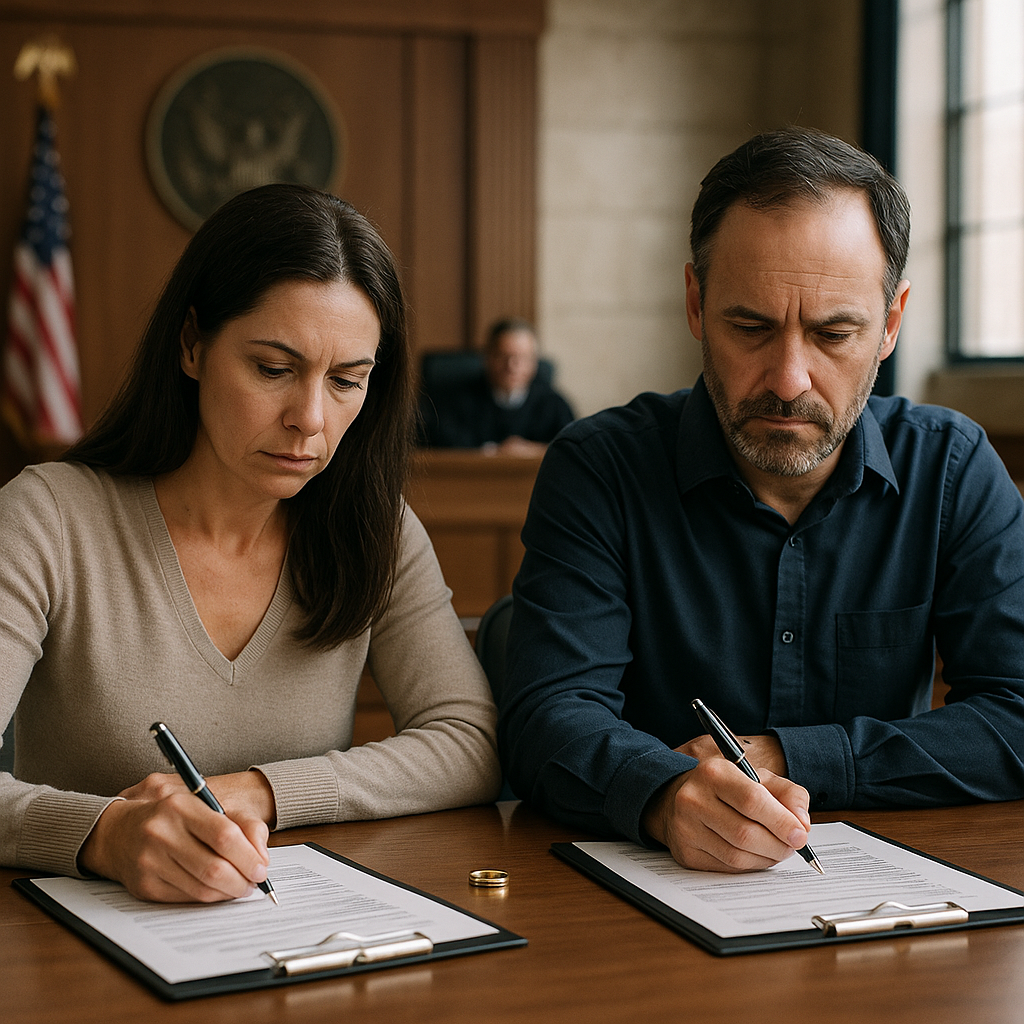
Can Mutual Divorce Work Without a Lawyer? Risks Few Couples Consider
Why More Couples Are Trying Mutual Divorce Without a Lawyer
You’re sitting across the dining table, both of you tired of fighting, and one thing is clear: you want this to end peacefully. The kids are asleep. The flat feels too small for all the tension. You agree on most things – property, custody, even who keeps the sofa. You look up mutual divorce online and see advice everywhere about hiring a divorce lawyer. But you wonder: can mutual divorce work without a lawyer? Will self-representation save you money or just add new headaches?
Mutual divorce without lawyer involvement sounds tempting. The fees for a single advocate can cross ₹60,000 in some cities. But is DIY divorce really as simple as filling out some forms and showing up at court? Family law in India looks simple on the outside, but even one mistake in legal documentation or court procedure can drag the process for months, sometimes years. Many couples only realise the risks when it’s too late.
If you’re thinking about self-representation for your mutual divorce, you’re not alone. But before you skip the lawyer, it’s smart to understand the hidden legal risks, paperwork traps, and court surprises waiting for the unprepared. This article breaks down what “mutual divorce without lawyer” really means, why some couples succeed, and why others regret trying to save on legal fees.
Quick Answer: Can You Get a Mutual Divorce Without a Lawyer?
Yes, you can file for mutual divorce without a lawyer in India if both parties fully agree on all terms. However, there are significant legal risks and paperwork pitfalls. Most couples underestimate the complexities of family law, legal documentation, and court procedure. Missing a step or making errors can delay or even derail your divorce.
What Is Mutual Divorce Without a Lawyer?
Choosing mutual divorce without lawyer support means both spouses file their divorce petition jointly, represent themselves in court, and handle all paperwork independently. This is sometimes called DIY divorce or self-representation.
Legal Definition and Context
Under Section 13B of the Hindu Marriage Act, 1955, mutual divorce allows both spouses to end their marriage by mutual consent. The law doesn’t require a divorce lawyer, but it does require precise legal documentation and full agreement on key issues:
- Division of property and assets
- Child custody and visitation
- Maintenance (alimony) and financial support
- Settlement of debts, loans, or joint liabilities
How Self-Representation Works in Indian Family Law
You and your spouse prepare the joint petition, sign affidavits, and appear before the family court judge. Everything from the drafting of the petition to the final statement in court must be handled by you, not a divorce lawyer. Courts do not provide legal advice or check your paperwork for errors.
Why Some Couples Choose DIY Divorce
- Cost savings: Avoiding lawyer’s fees can save ₹30,000 to ₹1.5 lakh depending on city and case complexity.
- Privacy: Some prefer not to share details with outsiders.
- Control: You set the terms, not a third party.
But these benefits come with risks. Even a small paperwork mistake can mean extra court dates, more stress, and sometimes a failed divorce petition.
Common Misconceptions
- “If we agree on everything, court is just a formality.” Not true. Indian courts are strict about procedure, documentation, and mutual consent.
- “Online divorce is always faster.” Many online services only help with forms, not legal advice or court appearances.
- “Lawyers just drag things out for money.” While some may, experienced divorce lawyers actually help you avoid costly mistakes.
The Step-by-Step Process of Mutual Divorce Without Lawyer
Filing for mutual divorce without lawyer help involves a sequence of legal steps. Missing any can send you back to the start.
1. Agreement on All Terms
Both spouses must agree on every detail:
- Division of flat, car, jewellery, and savings
- Custody and visitation schedule for children
- Maintenance (who pays, how much, for how long)
- Settlement of any joint debts or loans
Put everything in writing. Don’t rely on verbal agreements.
2. Drafting the Joint Petition
You’ll need to:
- Draft a joint petition under Section 13B of the Hindu Marriage Act (or relevant law for your religion)
- Include full personal details, marriage history, reasons for divorce, and a complete settlement
- Attach supporting documents: marriage certificate, address and ID proofs, photos, and affidavits
3. Filing the Petition in Family Court
- File the petition at the family court with jurisdiction (usually where either spouse lives or where marriage took place)
- Pay the court fee (varies by state, usually ₹100 – ₹500)
- Get a date for the first motion hearing
4. First Motion Hearing
- Both spouses appear in person and confirm all details before the judge
- Judge records statements and checks for genuine consent
- Court may suggest counselling, especially if children are involved
5. Six-Month Cooling-Off Period
- Wait for at least six months from the date of first motion
- Some courts may waive this period in rare cases (needs a written application and good reason)
6. Second Motion and Final Hearing
- Both spouses must appear again and confirm they still want divorce
- Judge reviews the case and settlement
- If satisfied, grants the divorce decree
7. Collecting the Divorce Decree
- Obtain the certified copy from court records
- Update personal documents (Aadhaar, PAN, passport, bank records)
Missing a single step or submitting incomplete documentation can cause delays or dismissal of your petition.
Legal Risks and Common Pitfalls in DIY Mutual Divorce
Filing for mutual divorce without lawyer guidance exposes you to several risks. Many couples only discover these after wasting months or losing their case.
Incomplete or Incorrect Legal Documentation
- Errors in names, dates, or addresses can invalidate the petition.
- Missing affidavits or incomplete settlement agreements lead to court objections.
- Some courts require very specific formats for petitions and annexures.
Settlement Pitfalls
- Vague or informal settlement terms can spark new disputes later.
- Not accounting for future changes in child custody or financial circumstances.
- Forgetting to include joint loans, EMIs, or tax liabilities in the settlement.
Court Procedure Surprises
- Family court judges have little patience for poorly prepared cases.
- If you or your spouse can’t attend a hearing, the court may dismiss the petition.
- Judges may ask tough questions. If you can’t answer, it raises doubts about genuine consent.
Irrevocability and Withdrawal
- Either spouse can withdraw consent at any time before the final decree.
- Withdrawal complicates matters and may force you into a contested divorce.
No Legal Advice or Safeguards
- Family court staff cannot give you legal guidance.
- If your spouse changes their mind or hides assets, you have no one to protect your interests.
Real-Life Example
Rohit and Anjali from Pune tried DIY mutual divorce. They forgot to include their joint home loan in the settlement. Six months later, the bank started sending notices to both, even though Anjali moved out. They had to return to court, hire a lawyer, and amend their agreement – costing more time and money than if they’d hired help from the start.
How Indian Family Courts View Self-Representation
Family courts in India do not require you to hire a divorce lawyer, but judges expect parties to understand the law, present correct documents, and follow procedure.
Court’s Role and Attitude
- Judges are neutral; they do not help you fill forms or draft petitions.
- If you make mistakes, the judge may adjourn the case, ask for corrections, or dismiss the petition.
- In rare cases, judges may refer couples to legal aid lawyers if they see confusion or exploitation.
Practical Courtroom Challenges
- Understanding when to stand, speak, or submit documents can be confusing.
- Some courts are crowded, noisy, and bureaucratic. You may have to wait hours for your turn.
- Language barriers: Most courts conduct proceedings in English or the local language. If you’re not comfortable, request a translator early.
How Judges Assess Mutual Consent
- Both spouses must appear in person, answer questions, and express free will.
- The judge checks if the agreement is voluntary, fair, and not hiding any facts.
- If there are children, judges scrutinise custody and financial arrangements closely.
Difference Between Urban and Rural Courts
- Metro city courts may be more familiar with mutual divorce without lawyer cases.
- Smaller towns sometimes expect parties to have at least basic legal help.
Comparing Mutual Divorce With and Without a Lawyer
Here’s a side-by-side look at how mutual divorce with and without a lawyer stacks up:
| Aspect | With Lawyer | Without Lawyer |
|---|---|---|
| Cost | ₹30,000 – ₹1.5 lakh+ | ₹1,000 – ₹10,000 (fees only) |
| Time taken | 6 – 12 months (average) | 8 – 18 months (often longer) |
| Documentation | Drafted and checked by expert | Self-prepared, error-prone |
| Settlement negotiation | Mediated, legally vetted | Direct, risk of loopholes |
| Court procedure | Guided through every step | Must learn everything solo |
| Risk of delay/dismissal | Low (if lawyer is competent) | High (mistakes common) |
| Peace of mind | Higher, less stress | Lower, more uncertainty |
Key Takeaways from the Comparison
- The main savings are on fees, but the risk of error is much higher without a divorce lawyer.
- If your case involves property, children, or financial complexity, legal help is strongly advised.
- DIY divorce may work for simple, childless marriages with no joint assets or debts.
Common Mistakes and How to Avoid Them
Many couples repeat the same errors when trying mutual divorce without lawyer guidance. Some are simple paperwork issues, others can cost you dearly.
Documentation Errors
- Using outdated or incorrect petition formats.
- Forgetting to notarise or properly sign affidavits.
- Attaching incomplete or blurry copies of documents.
Settlement and Consent Issues
- Not mentioning all assets or liabilities in the agreement.
- Relying on verbal promises instead of written, signed terms.
- One spouse agreeing under pressure, which can later be challenged.
Missing Court Dates
- Not tracking court dates carefully. Courts rarely send reminders.
- Failing to appear in person, which can lead to dismissal.
Not Planning for the Future
- Ignoring tax implications of property transfer or alimony.
- Not updating nominee details in insurance, bank accounts, or EPF.
Best way to avoid these mistakes: double-check every document, keep copies, and confirm all facts with your spouse before filing. When in doubt, consult a legal aid centre or a trusted lawyer for document review.
Best Practices for a Smooth Mutual Divorce Without Lawyer
If you’re set on self-representation, follow these steps to reduce risk and save time.
1. Educate Yourself About the Law
- Read Section 13B of the Hindu Marriage Act, or relevant law for your religion.
- Check your state’s family court website for rules, forms, and fee details.
- Join online forums or support groups for real-life tips.
2. Prepare All Documents in Advance
- Joint petition (drafted clearly, in the required format)
- Settlement agreement (detailed, signed by both)
- Affidavits, address proofs, marriage certificate, photographs
- Copies of bank statements, property documents, and loan agreements
3. Visit the Family Court Before Filing
- Ask the court clerk for a checklist of required documents.
- Find out about working hours, court holidays, and best times to file.
- Watch a few mutual divorce hearings if possible. It helps to see the process firsthand.
4. Be Honest About Disagreements
- If even a small point is disputed, resolve it before filing. Courts won’t settle disputes in mutual divorce.
- If you’re unsure, consider mediation or a single session with a legal expert.
5. Keep Communication Civil and Documented
- All agreements should be in writing and signed by both parties.
- Avoid emotional arguments in court. Stick to facts.
6. Prepare for Court Questions
- Practice answering questions about marriage breakdown, settlement terms, and custody plans.
- If you’re nervous, write down your main points and rehearse.
7. Plan for the Unexpected
- Have backup copies of all documents.
- If you or your spouse can’t attend a hearing, inform the court in writing as early as possible.
When Mutual Divorce Without Lawyer Makes Sense (and When It Doesn’t)
Not every couple is a good candidate for DIY divorce. It’s smart to know where to draw the line.
Good Candidates for Self-Representation
- No children or custody issues
- No shared property, loans, or business interests
- Both spouses are educated, speak the court’s language, and have mutual trust
- Settlement is simple and both are fully in agreement
Risky Situations: Lawyer Strongly Advised
- Disputes about child custody, visitation, or schooling
- Complex property division (multiple flats, ancestral property, joint ventures)
- High-value assets, business shares, or family trusts
- History of domestic violence, threats, or power imbalance
- One spouse is abroad or cannot attend court in person
Real-World Scenarios
- Simple case: Raj and Priya, married for two years, no kids, both working in Delhi, want a quick and peaceful separation. They file themselves, follow all steps, and get their decree in 7 months.
- Complex case: Neha and Arvind have two children, a family business, and investments in three cities. They try DIY, but confusion over custody and asset split leads to delays and court rejections. They eventually hire a divorce lawyer and resolve things in 14 months.
Recent Trends: Online Mutual Divorce and e-Courts
Post-COVID, Indian courts have started accepting some documents and hearings online. But does this mean mutual divorce without lawyer is easier?
Online Filing and e-Court Hearings
- Some states (Delhi, Maharashtra, Karnataka) allow online filing of mutual divorce petitions.
- First motion and second motion hearings are still mostly in-person, but some courts offer video hearings for NRIs or medical cases.
Online Divorce Services
- Many websites offer document templates or paid assistance.
- These services are not a substitute for legal advice. They do not represent you in court.
Limitations and Cautions
- Courts still require original signatures and in-person appearances for final statements.
- Online services may not update you on legal changes or new requirements.
- DIY online divorce is not recognised for all religions or in all states.
Future Outlook
- As e-courts expand, more paperwork may move online, but legal complexity remains.
- Legal aid clinics and government helplines are growing, but can be slow or crowded.
Frequently Asked Questions
What is mutual divorce without lawyer?
Mutual divorce without lawyer means both spouses agree on all terms, file the joint divorce petition themselves, and represent themselves in family court without hiring a legal advocate. It requires detailed paperwork and full cooperation.
Is mutual divorce without lawyer legal in India?
Yes, Indian law allows mutual divorce without a lawyer under Section 13B of the Hindu Marriage Act or similar provisions for other religions. There is no legal requirement to hire a lawyer, but the process can be complex.
What documents are needed for mutual divorce without lawyer?
You generally need:
– Joint petition for divorce
– Marriage certificate
– Address and ID proofs
– Joint photographs
– Settlement agreement
– Affidavits from both spouses
– Proof of income, property, and loans (if relevant)
Can the six-month cooling-off period be waived?
Yes, but only in rare cases. You must file a written application showing valid reasons (such as long separation or urgent circumstances). The judge has discretion to allow or deny the waiver.
What happens if one spouse withdraws consent?
If either spouse withdraws consent before the final decree, the mutual divorce petition is dismissed. You may have to file a contested divorce, which is longer and more expensive.
Is online mutual divorce possible in India?
Some states allow online filing of documents, but court appearances are still required. No fully online mutual divorce process exists yet. Beware of websites promising instant or guaranteed online divorce.
How much does mutual divorce without lawyer cost?
You pay only court fees, which range from ₹1,000 to ₹10,000 total (varies by state). If you use online services or document review, add extra charges. Lawyer fees are avoided, but mistakes can increase costs.
How long does the process take?
The minimum is 6 – 8 months, including the mandatory six-month cooling-off period. If documents are incomplete or hearings are missed, it can take up to 18 months or more.
Can NRIs file for mutual divorce without lawyer in India?
Yes, but at least one spouse must appear in person. Some courts may allow video hearings for NRIs. All documents must be notarised and sometimes apostilled if signed abroad.
What are the main risks of mutual divorce without lawyer?
- Documentation errors
- Settlement loopholes
- Missed deadlines or court appearances
- Lack of legal advice if disputes arise
Can mutual divorce be converted to contested divorce?
Yes. If consent is withdrawn or disputes arise, the mutual divorce petition is dismissed, and either spouse can file for contested divorce. This process is more time-consuming and costly.
Do family courts offer help with paperwork?
No. Court staff cannot give legal advice or help you draft petitions. You must prepare all documents yourself or seek outside help.
Is mutual divorce faster without a lawyer?
Not always. While you may save on coordination time, errors or incomplete paperwork often cause delays. An experienced divorce lawyer can actually speed up the process by avoiding mistakes.
What if one spouse is abroad?
If one spouse cannot attend in person, courts may allow video appearance or require a power of attorney. Check with your local family court for specific rules.
Can maintenance or alimony be decided later?
No. All terms, including maintenance, must be agreed upon and included in the joint petition. Courts will not accept incomplete settlements.
Key Takeaways
- You can file for mutual divorce without lawyer help in India, but it’s riskier than it looks.
- Every detail of settlement and documentation must be handled by the spouses themselves.
- Missing or incorrect paperwork can delay or derail your divorce.
- Courts expect you to know the law and procedure, even if you’re not a lawyer.
- Legal fees are saved, but mistakes can end up costing more in time and money.
- DIY divorce works best for simple, uncontested cases with no children or shared assets.
- Complex property, custody, or financial issues usually need legal expertise.
- Online services help with forms but do not represent you in court.
- Family courts do not provide legal advice or check your documents for you.
- Consider legal aid or document review if you have any doubts about the process.
Conclusion
Mutual divorce without lawyer support is possible, but it’s no shortcut. The law gives you the right to self-represent, but not a free pass to skip details. For couples with simple settlements and full trust, DIY divorce can work.
Still, most people underestimate the paperwork, court expectations, and legal risks. If there’s any doubt or complexity, a short meeting with a divorce lawyer often saves more than it costs. Before you file, weigh the savings against the stress and time lost if things go wrong. Sometimes, paying for peace of mind is the best investment.
